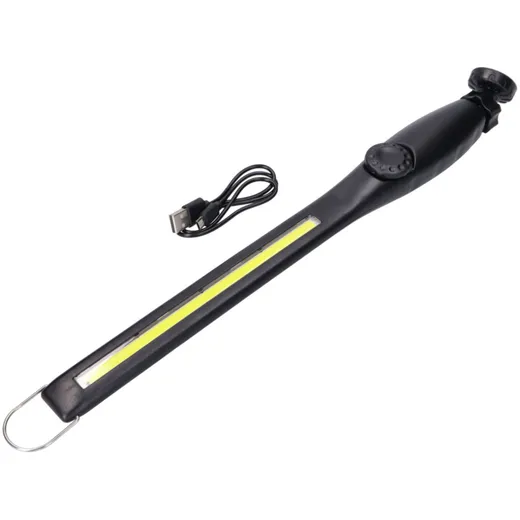

Cordless 5W LED work light AL-125 with 3.7V, 1,200mAh lithium-ion battery.
The neutral white COB LEDs are continuously dimmable (colour temperature 4500K). This workshop light has a 180° beam angle. Start-up time: 60% light is available in less than one second. This LED lamp can be hung either by the hook or the magnetic base. This magnetic base is not only strong, but also flexible adjustable via a ball joint. The robust housing is IP54 splash water protected. This slim work light has a size of 377x40mm and weighs only 160g.
The work light is charged via USB cable (power supply not included). One charge is enough for about 1-2 hours of operation. According to the manufacturer, a service life of up to approx. 20,000 hours and 20,000 switch-on and switch-off operations is possible.
Scope of delivery as shown on the product picture. An LED work light is supplied.
 Instructions for the disposal of electrical and electronic equipment:
Owners of old appliances must dispose of them separately from unsorted municipal waste. WEEE must therefore not be disposed of as unsorted municipal waste and, in particular, must not be disposed of with household waste. Instead, these old electrical and electronic devices must be collected separately and disposed of, for example, via the local collection and return systems. Owners of old electrical appliances must also separate old batteries and accumulators that are not enclosed in the old electric appliance from the latter before handing it in at a collection point. The latter does not apply insofar as the WEEE is separated from other WEEE in accordance with § 14 Paragraph 5 Sentences 2 and 3 ElektroG within the framework of opting by the public waste management authorities for the purpose of preparing it for reuse. Further information on the disposal of electrical equipment can be found at here